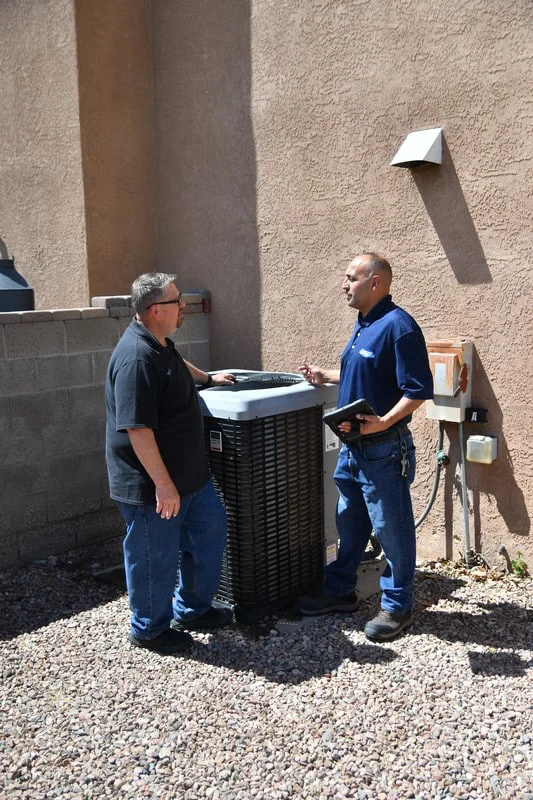
Yes, and we do it with numbers rather than opinions. Our technicians give you the repair cost and the replacement cost side by side, along with the unit’s age, its refrigerant type, its repair history, and a realistic estimate of remaining life — then you decide.
The Five Factors That Decide It
- Age. Under 10 years, repair usually wins. Past 15, replacement usually does. The 10–15 range is where the other factors break the tie.
- Repair history. One failure on an otherwise healthy system is normal. Two or more in consecutive seasons means you are funding an installment plan on aging equipment.
- Which part failed. A capacitor or contactor is cheap and worth fixing at almost any age. A compressor on a 14-year-old condenser almost never is.
- Refrigerant type. If the system runs R-22, a leak is effectively a replacement decision — the refrigerant is phased out, costly, and the leak will return.
- Efficiency and performance. If bills are climbing and the system no longer holds temperature on a 100-degree afternoon, you are already paying for a new system in utility costs.
A Practical Rule of Thumb
If the repair quote approaches a third of replacement cost on a unit past ten years, replacement is generally the better value. Below that, or on a newer system, repair is usually right. That is a starting point, not a formula — a $1,800 repair on a well-maintained 9-year-old unit is often smart money.
Why You Can Trust the Recommendation
Our technicians are not paid on commission, so nobody here has a financial reason to steer you toward the bigger ticket. If a $250 capacitor fixes it, that is the quote you get.
If Replacement Wins
We run a load calculation rather than matching the old tonnage, evaluate duct condition and insulation, and compare a straight AC replacement against a heat pump or hybrid system. Financing keeps an emergency from forcing an undersized choice.
Contact B. Carlson for a straight assessment in Albuquerque or Rio Rancho.